
AI Culling helps you quickly review and select the best photos from large projects, saving significant time and effort in one of the most repetitive stages of a photographer’s workflow. Whether you’re working with weddings, e-commerce, or any high-volume shoot, AI Culling accelerates image selection while maintaining professional quality standards.
Want to see AI Culling in action? Watch our step-by-step video tutorial below to learn how to maximize your efficiency and get the most out of this powerful feature.
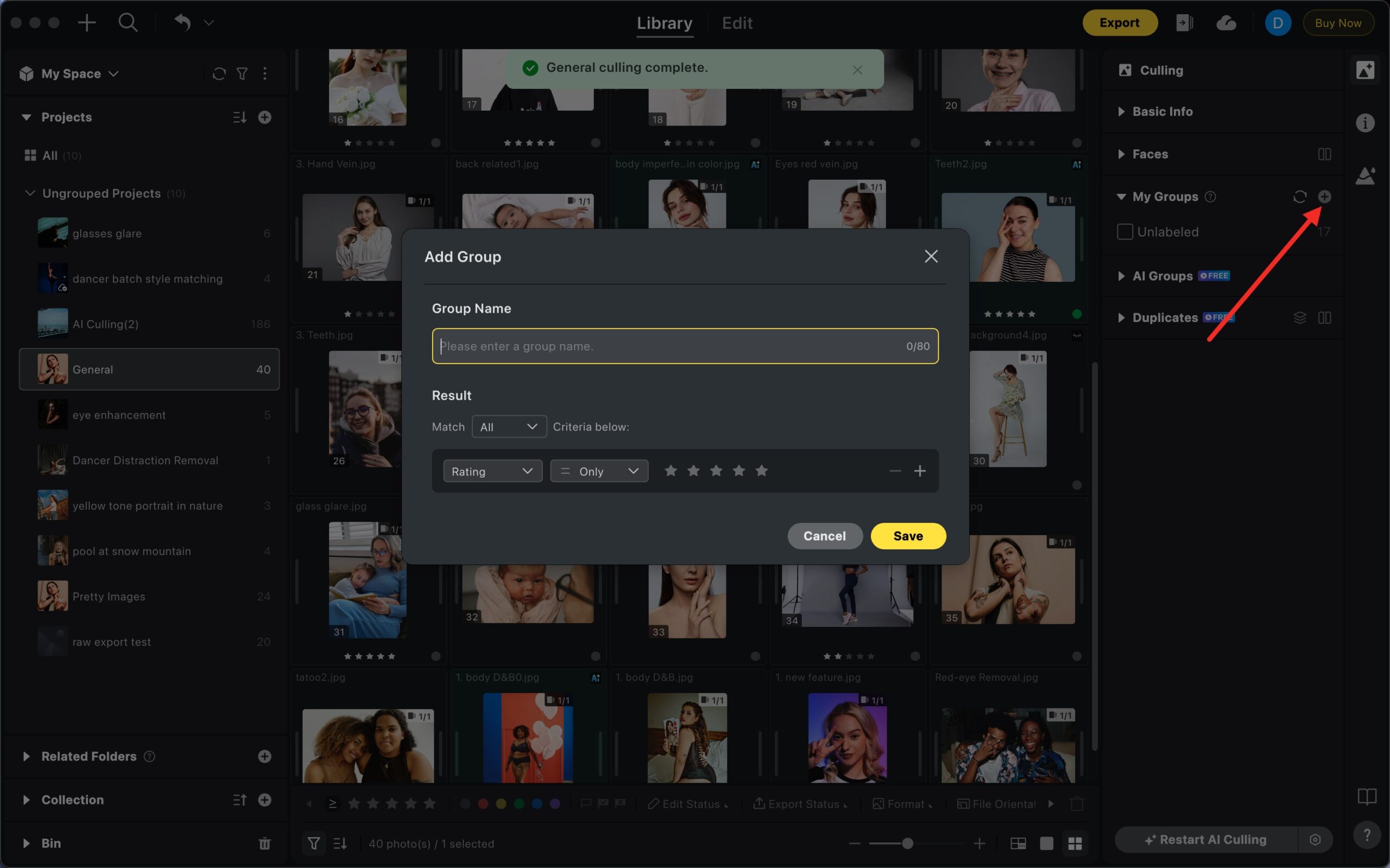
If you like to group images based on your stars and flags etc., in My Group you can set up fixed rules for grouping images based on certain conditions.
Where to Find Culling
The Culling feature is available in the Library panel, under the Culling tab on the right-hand side of the window.
The sub-panels within the Culling tab are organized as follows:
- Basic Info
- Faces
- My Groups
- AI Groups
- Duplicates
Note: AI Culling works only at the project level. It cannot be run on individual folders or collections.
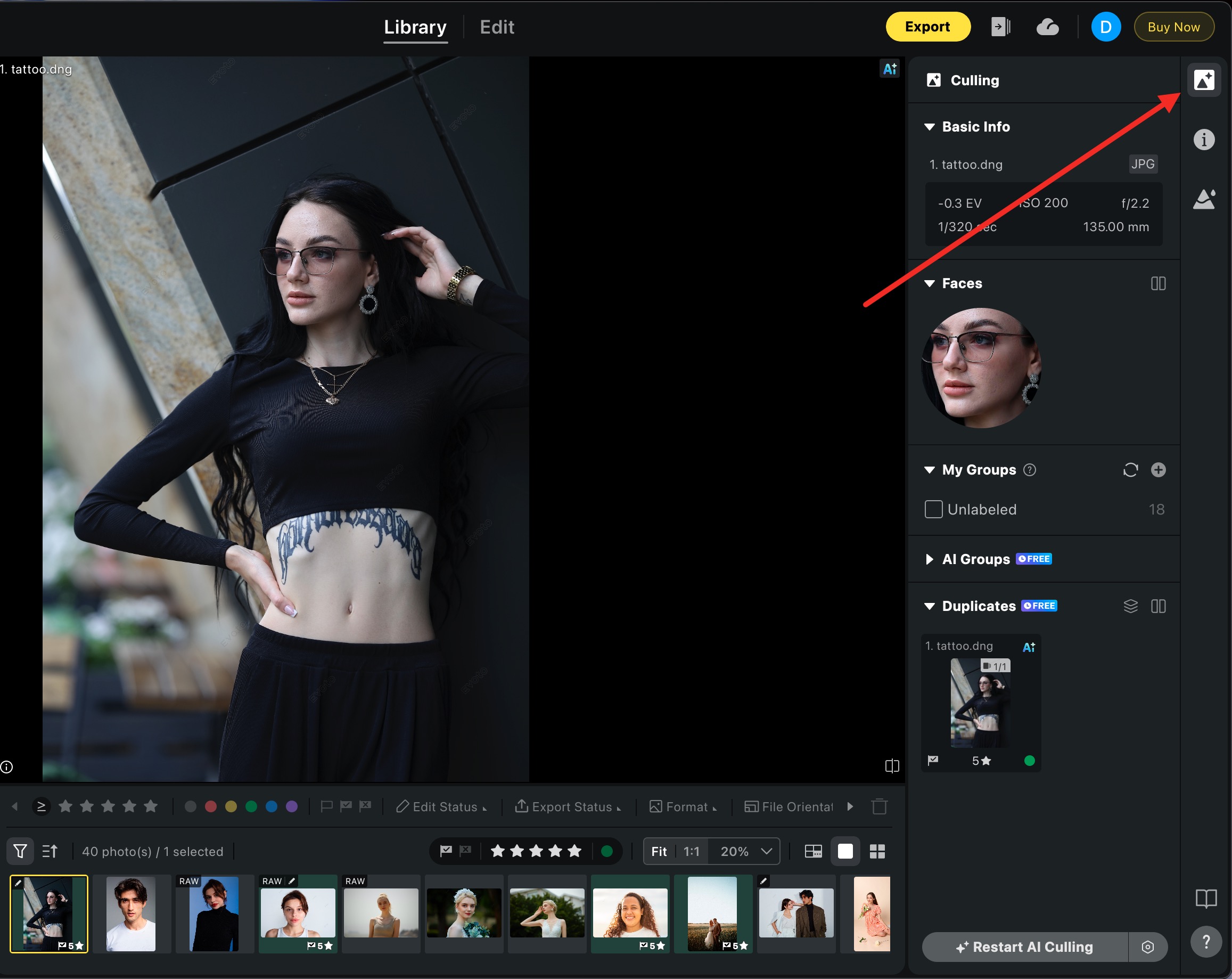
Subpanels Overview
Basic Info
Displays key metadata (shutter speed, lens info, etc.) for the selected image. This helps photographers quickly evaluate whether a shot meets their technical or stylistic requirements.
Faces
Shows enlarged previews of all detected faces in the selected photo. This allows you to check for focus accuracy and natural expressions at a glance.
- Face Focus Mode – A viewing mode that automatically centers and zooms on detected faces, making it easier to evaluate expressions and focus accuracy.
- Face Score Visualization – After AI Culling completes, each detected face displays quality assessment labels with color-coded visual indicators. This feature helps you instantly understand how the AI evaluates each face across multiple dimensions:
- Eye Status: Open Eyes / Half-Open Eyes / Closed Eyes
- Expression: Big Smile / Smile / Neutral
- Face Focus: In Focus / Soft Focus / Blurry
Hover over any label to see more details. In Face Focus fullscreen mode, hovering over a face displays all assessment labels for quick review.
- Face Library – Build and manage a library of recognized faces across your projects to quickly filter and find photos of specific people.
- Must complete AI Culling first to generate face library
- Different angles and expressions of same person automatically identified and categorized
- Multi-select supported for viewing photos of multiple people simultaneously
- Face library exists independently, does not interfere with time grouping, tag filtering, etc.
Perfect Shot
Within the Gallery interface, the Perfect Group Photo feature has been added under the Culling module. Users can select the best expression for each person from multiple photos of the same shoot, automatically generating a single ideal group shot.
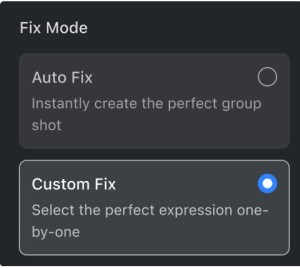
Fix Mode
- Auto Fix: The system automatically identifies and replaces faces with suboptimal expressions. Custom Fix can still be used after auto generation for manual selection.
- Custom Fix: Select individual faces to replace, preview available expressions, and manually choose replacements.
Apply Changes
Click Confirm to save the result. A new copy (tsq. format) is generated and saved in the same folder.
Notes
- Matching Range: Automatically searches the 7 photos before and after the current photo (14 in total) for replaceable faces.
- Matching Target: Only matches faces of the same person.
My Groups
Lets you create your own custom filters to group photos.
- It supports conditions based on star ratings, flags, and color labels.
- Conditions can be combined as All (AND) or Any (OR).
- You can add up to 10 conditions.
- Groups are global and apply across all projects.
- Default groups include:
-
- Unlabeled – all photos without labels
- Picked – flagged as selected
- Rejected – flagged as rejected
AI Groups
This subpanel automatically organizes photos based on AI tagging.
- AI Selections: Images that have been marked as the best by the AI.
- Candidates: The remaining images that have not yet been tagged.
- AI Unselected: Photos that have been marked as poor quality, which are further divided into categories like Blur, Overexposure, Underexposure, and Closed Eyes.
Note: A single photo may belong to multiple AI tags simultaneously.
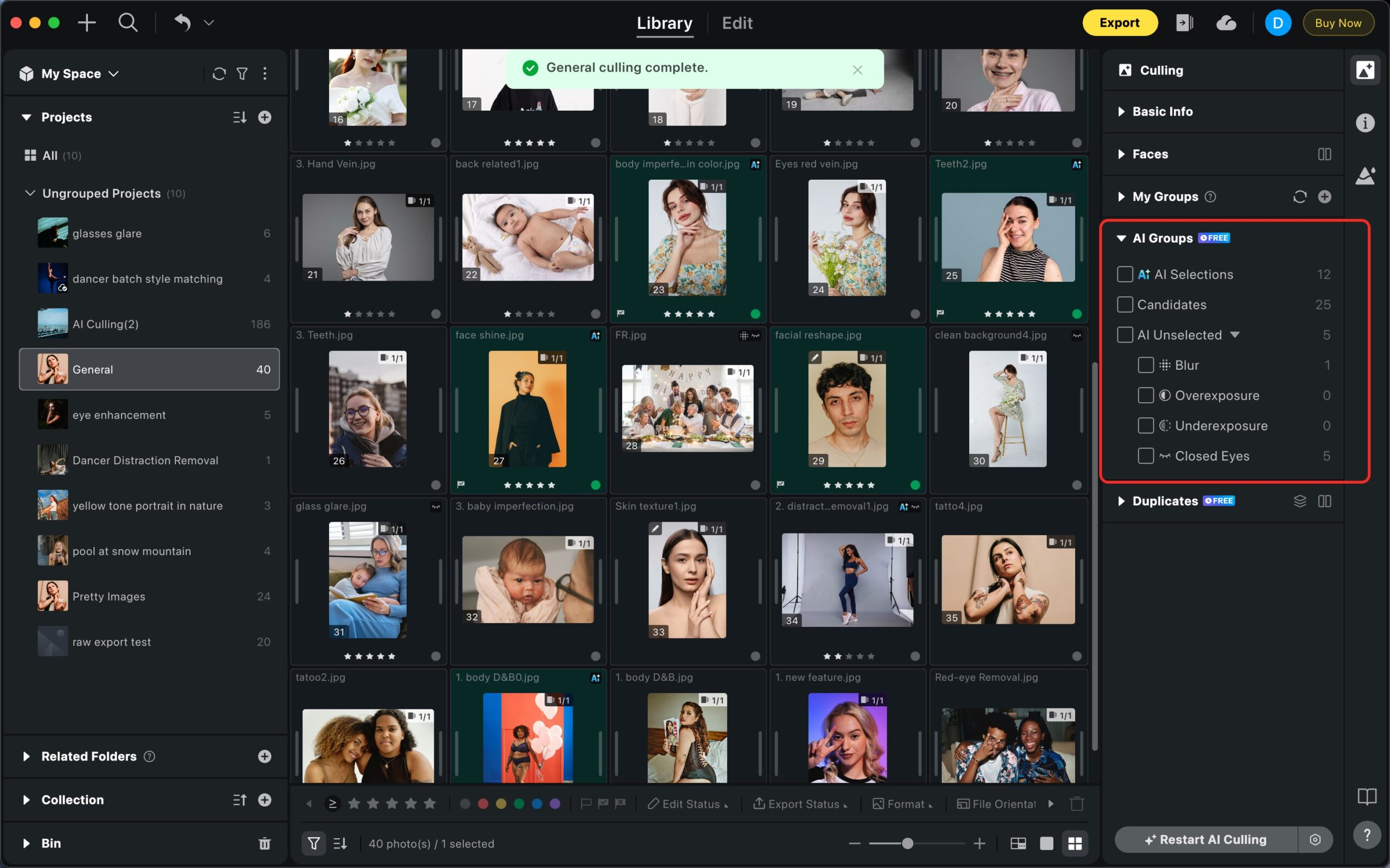
Photo Cluster
Intelligently group your photos to streamline the review and selection process.
- Time Interval: Photos are automatically grouped based on the capture time between shots. This helps you organize and review burst sequences or images from specific moments and sessions.
- Duplicates: Groups visually similar photos to help you manage near-duplicates. The AI uses quality scoring to identify the best photo in each similarity group, making it easier to filter out repetitive shots.
- Faces: Groups photos based on detected subjects. This allows you to review images by individual people to ensure you select the best expressions for each person.
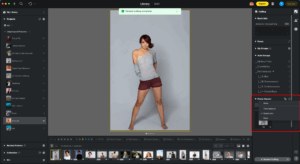
Starting AI Culling
To begin the AI culling process:
- Open a project in the Library.
- Navigate to the Culling tab on the right-hand side.
- Click Start AI Culling. The process will run across all photos in the project (it does not work on individual folders or collections).
- Once the process is complete, you can review the results in the subpanels.
Important: AI Culling is a Pro feature. Non-subscribers can view limited subpanels (Basic Info, Faces, and My Groups), but they cannot use AI Culling.
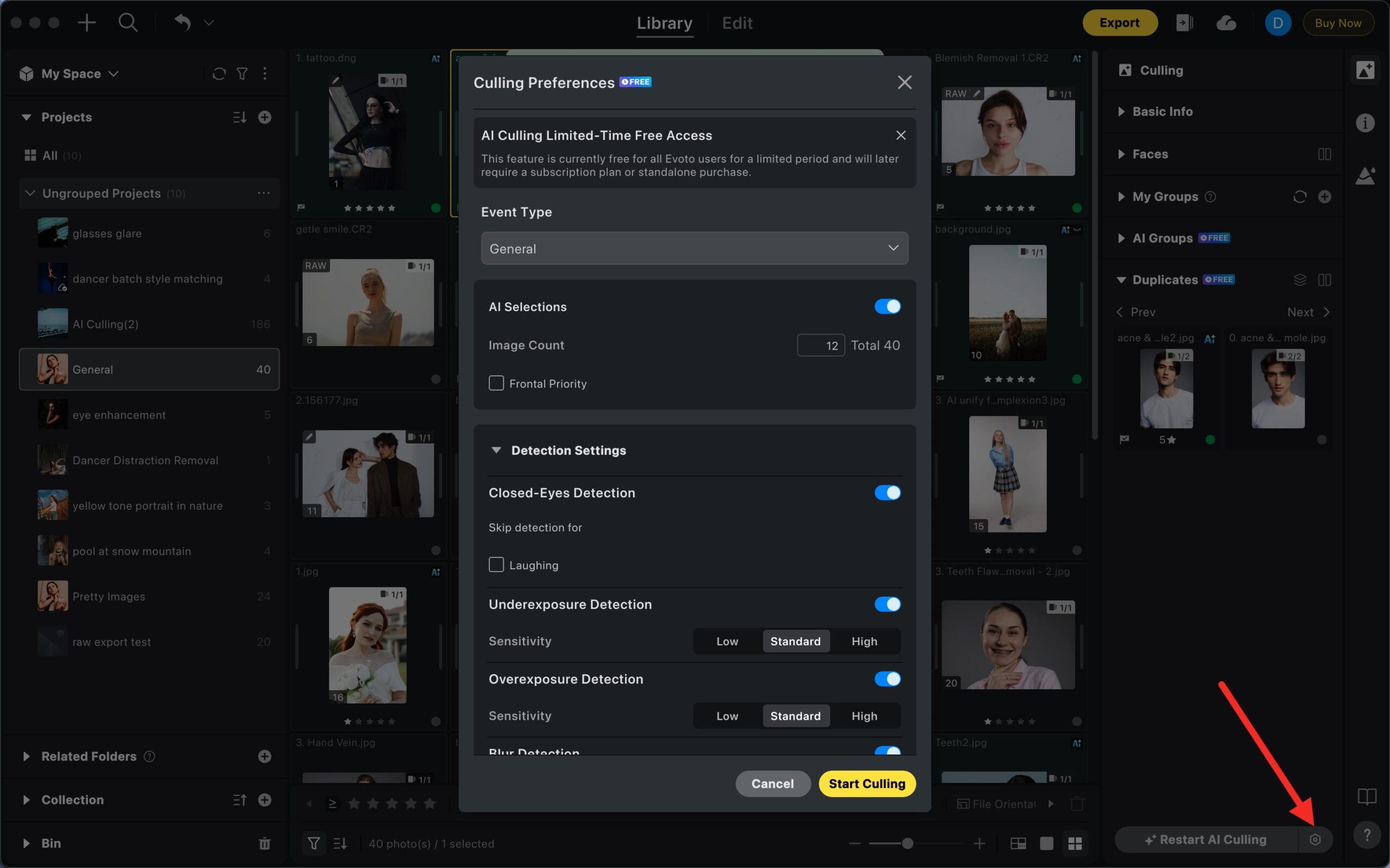
AI Culling Preferences
Settings can be accessed when starting Culling or from the bottom of the right-hand panel.
Project-Level Settings
- Event Type: Select the shoot type (e.g., wedding, product) to help the AI provide more accurate results.
- AI Selections: Users can set the number of images AI automatically selects and define selection rules.
- Limit total AI Selection photos: Enter a specific number, and the AI will choose the best photos from all images based on scoring and algorithm, up to the specified total.
- Limit AI Selection photos per cluster: Enter a maximum and minimum value for each group. The AI will select photos within each group according to these settings. Users can choose to select photos based on Duplicates or Face dimensions.
-
Duplicates: Displays the similarity cluster of the photo
-
Face: Displays the face cluster of the photo
- Time Interval: Sets the time threshold for grouping images. Photos taken closely together within this duration are grouped into one cluster for AI selection.
-
- Auto Tag Enhancement – Automatically adds different types of tags to photos based on AI judgment and user settings for more flexible photo status marking.
-
New Tag Types
-
Candidates: Photos AI considers acceptable quality but not meeting best standards
-
AI Unselected: Photos not selected by AI
-
-
- Auto Save Tags to Local – After AI Culling completes, automatically save tag results (stars, flags, color labels) to photo metadata as XMP sidecar files, compatible with Lightroom and other software.
Global Settings
- Closed Eyes, Blur, Exposure Detection: Adjust the sensitivity levels for these features.
- Duplicate Detection:
- Adjust the grouping sensitivity.
- Define the minimum number of selections per group. This means Evoto must select certain number of photos from each group.
Note: If you set both a total number of photos to be selected and a minimum number of photos per group, AI Culling will prioritize the total number. As a result, the final selection may not strictly match the per-group minimum you specified.
After Culling
- Once the culling process is complete, photos are displayed with the AI-applied tags.
- Projects with duplicate detection enabled will automatically switch to Group Sorting.
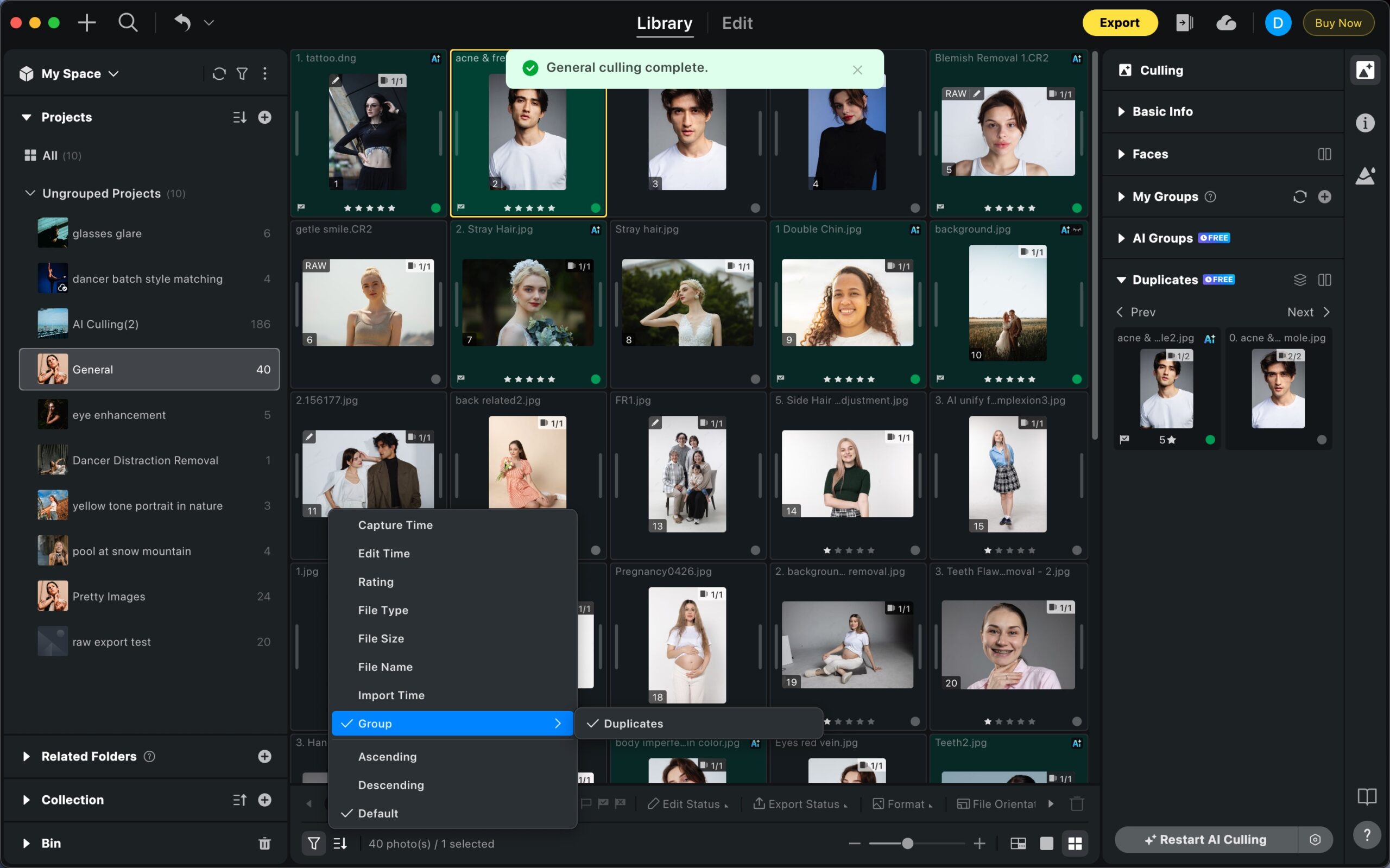
- You can manually switch sorting modes in the bottom-left panel.
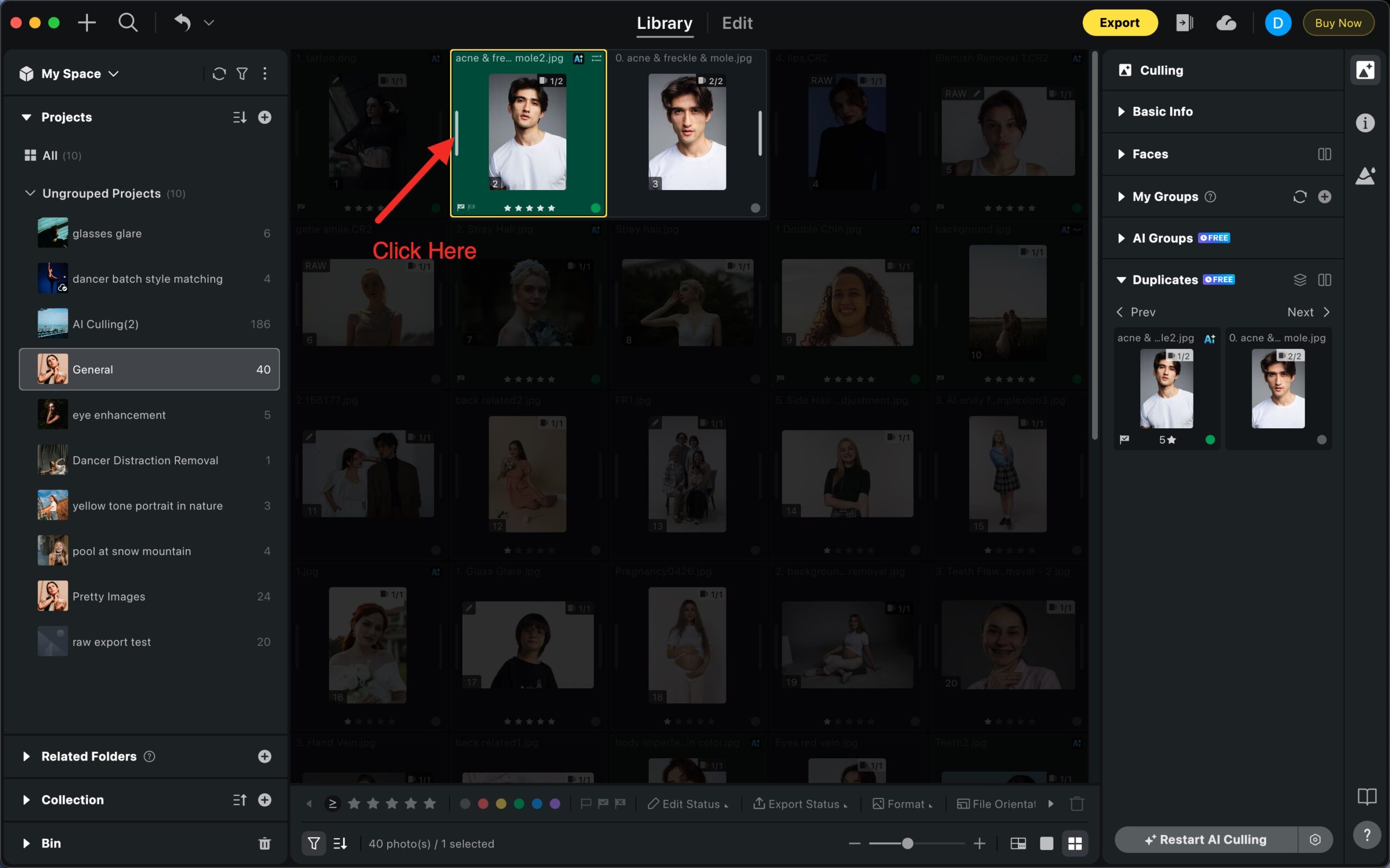
- To get a closer look at grouped images, click on the group bars in grid view to enter Focus Mode.
Limitations During Culling
While AI Culling is running, the following actions are temporarily unavailable:
- Deleting projects or photos.
- Applying manual ratings (stars, flags, colors).
- Adding photos to the project.
- Using tethered capture.



 日本語
日本語 한국어
한국어 Español
 繁體中文
繁體中文 Português
 Tiếng Việt


